
Prime Minister Narendra Modi began his engagements in the US on Thursday by meeting with leading American CEOs from five different key sectors and highlighted the economic opportunities in India.

Given that some reputed builders are also present in this segment and the cheap rates, does affordable housing make a good investment option?

'I don't think we have ever seen such alignment of everything that we need in the banking sector.'

20 new industrial clusters will be developed in 2014-15.
Analysts said the higher capex by PSUs, along with government spending, could trigger a capex revival for the corporate sector by the second half of FY17
Stating that recent agriculture reforms have opened new opportunities, the RBI Governor said the farm sector is emerging as a bright spot.

India was among the top-five economies with the largest general government capital stock level, said, in 2015, an International Monetary Fund report called "Making Public Investment More Efficient". The report fuelled a debate on countries sitting on piles of cash that could be used better. India was believed to have public assets worth $4.5 trillion. The report urged countries to start asset recycling. Six years after the report, Australia's success in asset recycling has turned India into a believer; despite doing averagely in its previous efforts on roads, railways or meeting its divestment targets.

The government will amend the six-and-a-half-decade old Essential Commodities Act to deregulate food items, including cereals, edible oil, oilseeds, pulses, onion and potato, Finance Minister Nirmala Sitharaman said on Friday. The amendment, besides deregulating production and sale of food products, will provide for no stock limit to be imposed on any produce.

Govt to chalk out entry of sovereign funds from Abu Dhabi, Qatar into such projects.

Modi announced a USD 14-million grant for community development projects in the Caricom and another USD 150 million line of credit for solar, renewable energy and climate- change related projects, a statement released by the Ministry of External Affairs said.

At the outset, decide whether you want to be a trader or an investor, suggest Sarbajeet K Sen and Sanjay Kumar Singh.

The Singapore Minister applauded Prime Minister Modi's effort to make India the manufacturing hub of the world.

India will encourage greater investments in Sri Lanka's economy, especially in areas of energy, tourism and infrastructure, External Affairs Minister S Jaishankar said on Friday, as he expressed India's solidarity with the debt-ridden Island nation during its "difficult moments".
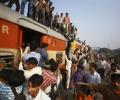
Indian Railways need a facelift, says Suresh Prabhu.

sharper-than-expected economic recovery back home, analysts say, can fuel a further rally in domestic cyclicals, industrials, and financials as global central banks continue with their easy money policy.

If India wants to become a globally competitive manufacturing hub, it will have to rethink the notion that the traditional SMEs will form the manufacturing backbone, argues Prosenjit Datta.
Jaitley said growing at 8-10 per cent for a significant number of years will help India find an answer to poverty.
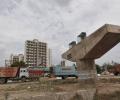

The Budget decides to take the lead in revving up infrastructure.
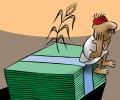
Sitharaman also announced Rs 10,000 crore fund to support 2 lakh micro food enterprises for promoting health and wellness, herbal, organic and nutritional products.
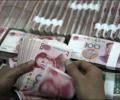
The NDB will have an initial authorised capital of $100 billion.

Unfortunately, in India, infrastructure projects are lost in a miasma of political and personal vanity, observes Shyam G Menon.

Identifying the need for Rs 1,72,000 crore (Rs 1720 billion) investment in national highways, the Economic Survey on Monday asked the government to gear up policies and institutions to meet specific requirements while increasing the outlay for road s
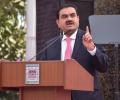
So far the government has been silent on the charges being levelled, even after the stock price rout. Perhaps it is hoping for the share price to settle so that the matter goes away, predicts Aakar Patel.

Of the 59 IPOs for which the data is available, 36 IPOs received mega responses of more than 10x (of which, six IPOs more than 100x), while eight IPOs were oversubscribed more than 3x.

Kerala's election discourse operates surreptitiously. Its explicit face focuses on important national and local issues. At the same time, it seeks to secure apt communal equations to ensure votes, notes Shyam G Menon.

Finance Minister Arun Jaitley presented the Union Budget.

The Indian economy can contract by 7.7 per cent in current financial year ending on March 31 and the growth could be 11 per cent in the next financial year, according to the Economic Survey tabled in Parliament by Finance Minister Nirmala Sitharaman. The contraction in FY21 is mainly due to coronavirus (Covid-19) pandemic and the visible damage caused by the subsequent countrywide lockdown to contain it. The survey unveiled two days before the Union Budget is broadly in line with forecasts by the Reserve Bank of India (RBI) which has said it expected the country's GDP to contract by 7.5 per cent in the year ending March 31.
Political funding of elections has led to the rise in black money in the economy.

Progress on several parameters creates a tipping point situation.

Assessing the shape of the Indian economy just a couple of days ahead of the Union Budget for 2016-17, Saugata Bhatacharya, senior vice president and chief economist, Axis Bank, speaks about his budget wishlist and suggests measures that can help finance minister Arun Jaitley achieve the targeted fiscal deficit of 3.5 per cent of India's gross domestic product.

'An area of land has already been earmarked for their protected habitation.' 'There are also steps being taken to take care of the coral zone and mangroves.'
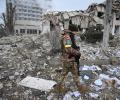
Reconstruction efforts after the Russia-Ukraine war will be dominated by the heft of the membership of major nations across international organisations. India is hamstrung because it does not play host to any major global institution nor does it hold positions of significant influence in the ones in which it has membership. As a result, the world's sixth largest economy is obliged to follow the rules set by most of them.

India and Saudi Arabia on Monday called on states to reject the use of terrorism against other countries and prevent access to weapons, including missiles and drones, to commit acts of terror.

The Indian economy is rapidly normalising towards pre-pandemic activity levels, even as uncertainty exists about coronavirus mutations and repeated infection waves, industrialist Kumar Mangalam Birla said on Wednesday. Vaccination is picking up pace, which would improve India's resilience against a potential third wave, the chairman of Aditya Birla Group said while virtually addressing shareholders at the AGM of group firm UltraTech Cement Ltd. Moreover, various steps taken by the RBI and the government have helped in containing the economic disruptions of the pandemic, Birla added.
Gadkari said the NHAI was working on setting up an InvIT to monetise its projects for mobilising resources through capital markets.
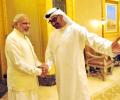
Apart from key bilateral issues, the two leaders also discussed situation in the region, particularly in wake of the increasing threat of terrorism and extremism from various sources including the Islamic State militant group.
To make sure liquid schemes reflect the underlying portfolio risks, Sebi has said all debt papers with maturity of 30 days or more to be marked to market. Earlier, fund houses didn't have to do so for securities that had less than 60-day maturity.
'India has benefited from lower oil prices and remains the fastest-growing large economy in the world.'
However, the budget arithmetic is slightly optimistic.
